
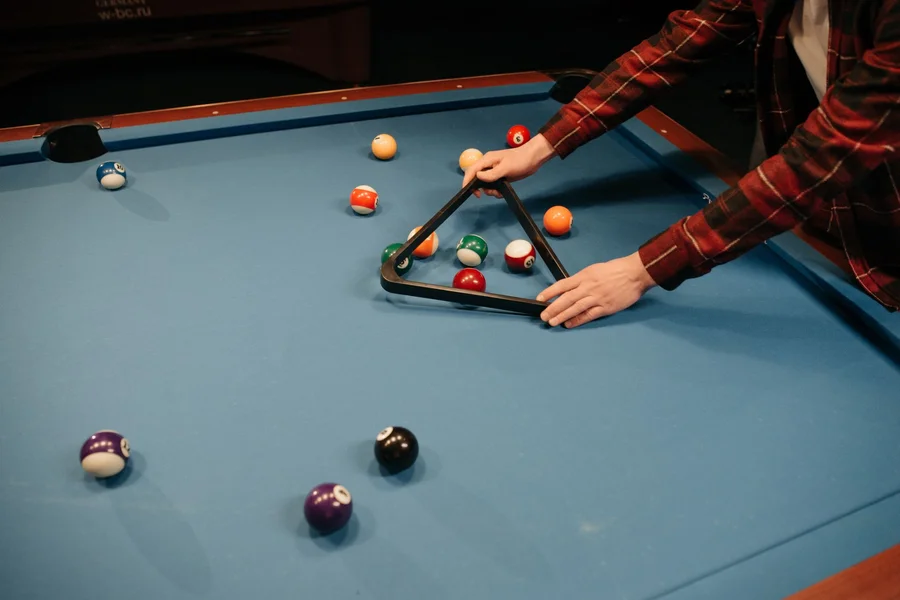
Pool Triangle Set Up: The Ultimate Guide to Racking Billiards Perfectly
Billiards is a sport defined by angles, physics, and strict rules of engagement. Whether you are hosting a friendly game night in your basement or competing in a local tournament, the foundation of every match starts with the rack. Learning the correct pool triangle set up is essential for ensuring fair play and achieving a clean, explosive break. While it may seem as simple as putting fifteen balls in a plastic frame, official billiard regulations specify precise placements and alignments that every player should master.
Racking rules differ significantly depending on the game format you are playing, whether it is classic 8-ball, fast-paced 9-ball, or technical straight pool. This comprehensive guide covers the precise setups for each variation, the physics behind a tight rack, the terminology you should know, and helpful tips for home tables.
The Physics of a Perfect Pool Rack
Before diving into specific ball placements, it is important to understand why a proper rack is so critical. In billiards, when the cue ball strikes the front ball of a rack, kinetic energy is transferred through the cluster. If the balls are racked loosely with visible gaps between them, the energy from the break disperses unevenly, resulting in a sluggish split where few, if any, balls find a pocket.
To achieve a powerful break, the balls must be “frozen” (firmly touching one another). A tight rack allows the kinetic energy to transfer cleanly from the apex ball through the entire triangle, scattering the balls widely across the table. For families looking to integrate healthy indoor pastimes, setting up a pool table is one of the best family games to enjoy together, teaching kids both geometry and sportsmanship.
“A loose rack benefits the defender, while a perfectly tight, frozen rack rewards the breaking player with maximum ball movement and pocket opportunities.”

Step-by-Step 8-Ball Pool Triangle Set Up
8-Ball is the most popular billiard game played worldwide. Racking for 8-ball requires a standard fifteen-ball triangular rack. The official racking guidelines set by the Billiard Congress of America (BCA) are highly specific:
- Place the Apex Ball: The ball at the front tip of the triangle (the apex) must sit directly over the foot spot of the table. The foot spot is the small sticker or marked point located on the lower third of the pool table. Contrary to popular belief, the apex ball does not have to be the 1-ball; it can be any solid or stripe.
- Position the 8-Ball: The black 8-ball must be placed in the exact center of the triangle. This position corresponds to the middle of the third row of balls.
- Arrange the Bottom Corners: In the two bottom corners of the triangle, you must place one solid ball and one striped ball. It does not matter which side has the solid or the stripe, as long as they are opposite.
- Arrange the Rest Randomly: The remaining twelve balls should be arranged randomly around the 8-ball and the corners. Alternating solids and stripes throughout the rest of the rack (called “pattern racking”) is illegal in official tournament play.
Racking for 9-Ball: The Diamond Setup
9-Ball is a fast-paced game that uses only the first nine object balls (1 through 9). Instead of a large triangle, 9-ball is racked using a diamond-shaped frame. The rules for a 9-ball setup are strictly defined by the World Pool-Billiard Association (WPA):
- Apex Position: The 1-ball must always be placed at the very front apex of the diamond, directly over the foot spot.
- Center Position: The 9-ball must always be positioned in the exact center of the diamond rack.
- Other Positions: The remaining balls (2 through 8) are placed randomly around the 9-ball. The order of these balls does not matter as long as the 1-ball is at the front and the 9-ball is in the middle.
Overview of Billiard Racking Rules
| Game Format | Rack Shape | Apex Position | Center Position | Corner Requirements |
|---|---|---|---|---|
| 8-Ball | Triangle (15 Balls) | Any ball (placed on Foot Spot) | Black 8-ball | One solid, one stripe in opposite corners |
| 9-Ball | Diamond (9 Balls) | Yellow 1-ball (placed on Foot Spot) | Yellow/Green 9-ball | No corner requirements (randomized) |
| Straight Pool (14.1) | Triangle (15 Balls) | Any ball (placed on Foot Spot) | Randomized | 1-ball in right corner, 5-ball in left corner |
Tips for Achieving a Tight Rack on Home Tables
Racking can sometimes be frustrating on home tables, especially if the cloth is worn or the table is not perfectly level. If you have built an entertainment space at home featuring pool tables, classic arcade games, or table tennis, keeping your gear well-maintained is vital. Here are some expert tips for homeowners to keep their pool equipment in top shape:
- Use Your Fingers to Nudge: Before lifting the wooden or plastic triangle off the balls, place your fingers inside the back corners and push the balls forward toward the apex. This ensures they are tightly packed against each other.
- Inspect Your Balls for Damage: Dirt, chalk residue, and small chips can prevent balls from settling together cleanly. Clean your billiard balls regularly with warm water and mild soap.
- Consider a Magic Rack: If you struggle with gaps, look into thin, modern plastic racking sheets (often called Magic Racks). These lay flat on the cloth under the balls and ensure a perfectly tight, frozen rack every single time, lifting away effortlessly after the break.
Pairing these tips with other fun activities at home helps create an engaging, active environment for family and friends alike.
Frequently Asked Questions
Does the 1-ball have to be at the front of the rack in 8-ball?
No. In 8-ball, any solid or stripe can sit at the apex of the triangle. The only rule for the apex is that it must sit directly on the foot spot of the table. Only in 9-ball is the 1-ball required to sit at the apex.
What is the foot spot on a pool table?
The foot spot is the point on the table’s cloth where the imaginary lines connecting the second side pockets and the bottom corner pockets intersect. It is typically marked with a small round sticker or emblem.
What happens if the rack is loose during the break?
A loose rack disperses the energy of the cue ball poorly, causing a bad spread. If a player notices the rack is loose before the break, they have the right to request a re-rack to ensure the balls are tight and frozen.
Is pattern racking allowed in leagues?
No, pattern racking (deliberately organizing solids and stripes in a specific order to control where they scatter) is prohibited in most leagues, including APA and BCA, to keep the game completely fair.

Written by Rosella
Rosella is a self-taught digital creator with a passion for breaking down tech, lifestyle, and everyday topics into simple, easy-to-understand content. Based in Youngstown, Ohio, she brings a curious, multi-disciplinary approach to writing, covering everything from the latest tech trends to practical life hacks and personal growth insights.
Her goal is straightforward: take complicated ideas and explain them in a way that actually makes sense, so every reader, whether a total beginner or someone more experienced, walks away having learned something useful. When she’s not writing, you’ll usually find her exploring new tools, sharpening her skills, or spending time with family.
Through this blog, Rosella aims to build a community centered on real, actionable insights rather than fluff, jargon, or filler content.
